Lincoln Electric announced XpertLINC on October 20, 2026, describing a platform that brings joint sensing, coordinated robot motion and welding-process control together. The initial rollout is on its Cooper welding cobots, with broader application across its automation offering planned over time.
An adaptive process, as described by the supplier
According to the announcement, the operator indicates the beginning and end of a weld. The system scans actual joint conditions, assesses fit-up and generates coordinated movement and process parameters with reference to customer-defined welding procedure specifications. Lincoln Electric says it can adapt to part variation and flag parts outside the permitted conditions for review.
These are supplier descriptions of the intended capability. The release does not provide an independent comparative production trial from which a fabricator can calculate a guaranteed improvement for its own parts.
What a useful demonstration should show
Our practical interpretation is that the evaluation should focus on variation, not just a well-prepared demonstration joint. Bring representative production parts and define the range of acceptable fit-up before the trial begins.
Ask the supplier to demonstrate what happens when a part remains within that range, when the scan is uncertain and when the part falls outside it. Record the operator actions in each case. A system that can identify an exception still needs a clear process for holding, reviewing and releasing that part.
Use agreed measures for the trial: setup effort, cycle time including handling, inspection results and the work required to recover from an exception. Keep those measures separate so a shorter programming step does not hide additional preparation or rework elsewhere.
Connect adaptation to production control
For a production proposal, ask who approves the parameter envelope, how changes are recorded and how the resulting weld records connect to the part. Include operator training and cell integration in the project scope. Adaptive operation does not, by itself, establish the complete cell’s acceptance requirements.
The announcement is relevant to fabricators dealing with changing joints and fit-up. Its value for a particular shop should be assessed against that shop’s actual mix, documented process limits and accepted weld quality.
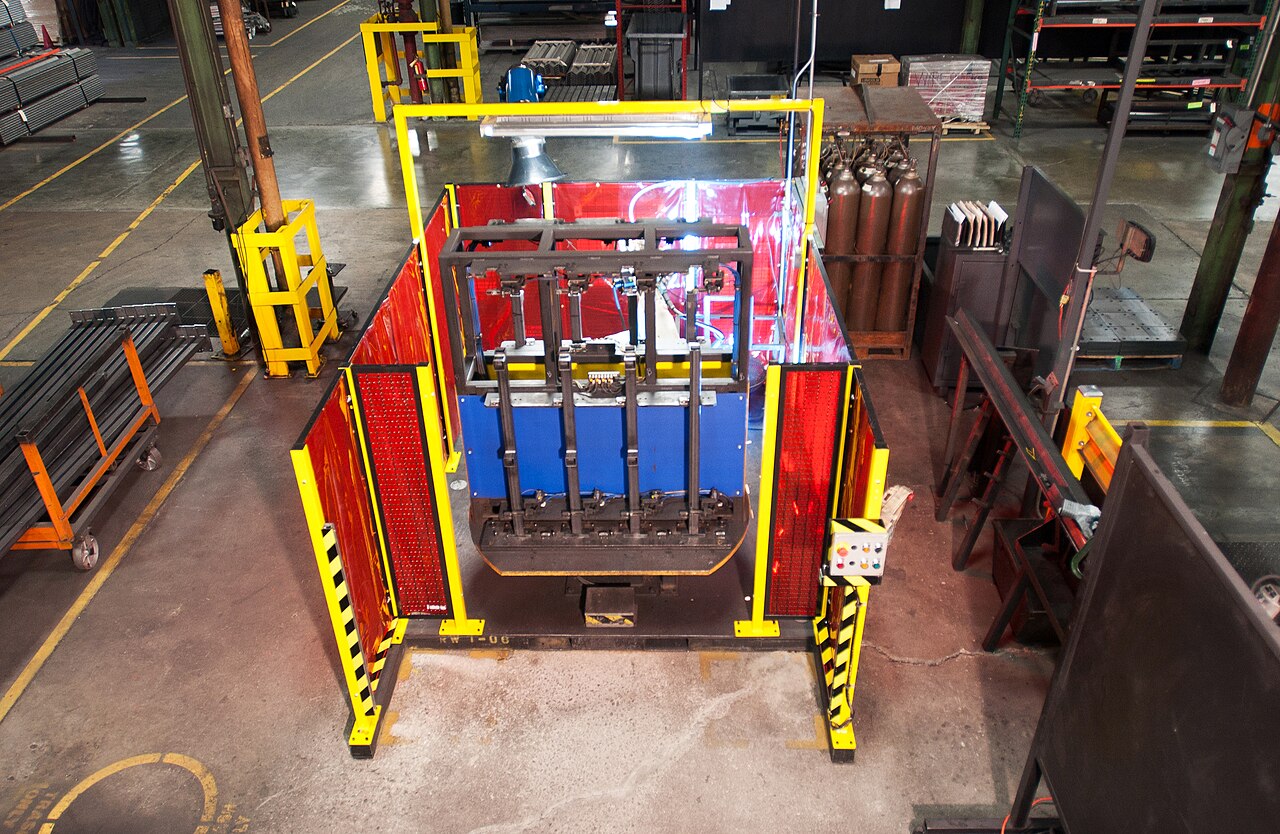
The reference photograph shows a guarded robotic welding cell; it is not a photograph of XpertLINC or a Cooper installation.
Further reading
Lincoln Electric - XpertLINC launch announcement, October 20, 2026 ↗