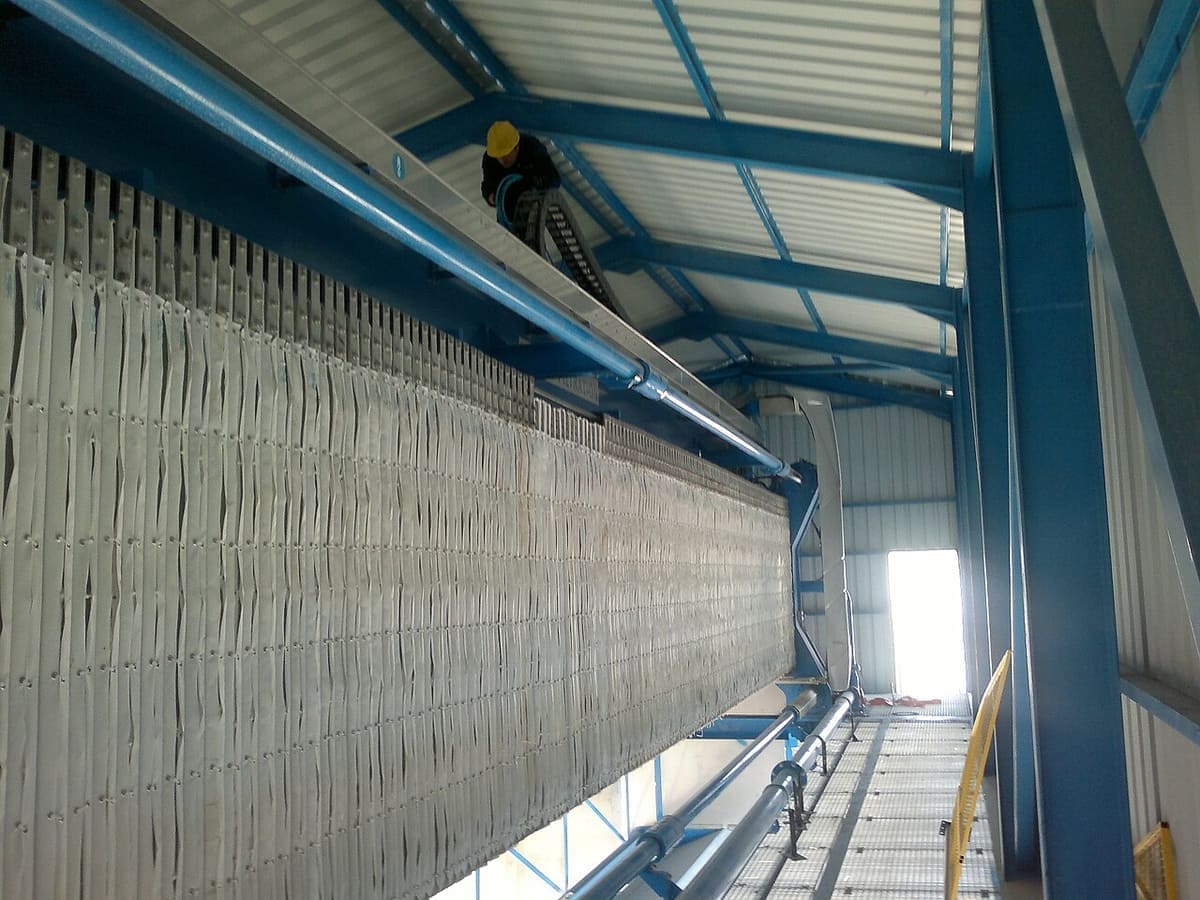
Every sludge dewatering shortlist contains the same three machines: a filter press, a belt press and a decanter centrifuge. All three turn liquid sludge into a stackable cake, but they part company on the points that decide operating cost for years afterwards: how dry the cake leaves, whether the machine works in batches or continuously, how much floor space and operator time it consumes, and how it copes with your particular sludge. This guide compares the three on published evidence — US EPA technology fact sheets, manufacturer data and one full-scale side-by-side trial — and ends with the checks to complete before signing for any of them.
The three technologies at a glance
| Filter press | Belt press | Decanter centrifuge | |
|---|---|---|---|
| Operating mode | Batch: fill, filter, open, discharge | Continuous: sludge squeezed between two moving belts | Continuous: rotating bowl with internal scroll conveyor |
| Cake dryness | Highest of the three, per US EPA | Strongly sludge-dependent; digested sludges at the wet end | Mid-range; 20 to about 23% dry solids in a full-scale municipal trial |
| Solids capture | Highest of the three, per US EPA | Below filter press; confirm by trial | High; about 99% recovery in the same trial |
| Footprint | Press plus room to handle cake discharged in batches | Long machine plus a belt-washing station | Smallest per unit of capacity |
| Operator demand | Attention at filling and discharge; unattended while filtering | Low staffing, but needs watching when feed quality swings | Minimal; designed for automated, unattended running |
| Polymer | Low chemical and polymer use, per ANDRITZ | Dosed before the gravity zone; EPA data spans 1 to 10 kg per tonne of dry solids | 2.5 kg per tonne of dry solids in the Finnish trial |
Cake dryness decides the disposal bill
Haulage and gate fees are charged on wet tonnes, so every point of cake dryness removes water you would otherwise pay to transport. The US EPA’s recessed-plate filter press fact sheet states that recessed-plate filter presses produce the highest cake solids content and the highest rate of solids capture compared with belt presses and centrifuges, and describes their cake as ranging from a custard consistency at 12 to 15 percent solids to a moist-soil consistency at 20 to 40 percent solids. US EPA
Belt press dryness moves with the sludge at least as much as with the machine. The performance table in the US EPA’s belt filter press fact sheet, for high-pressure machines, runs from 28 to 44 percent cake solids on raw primary sludge down to 12 to 22 percent on anaerobically digested waste activated sludge. US EPA A centrifuge sits between the two on typical municipal sludge: in Alfa Laval’s full-scale comparison at a Finnish wastewater plant serving about 12,000 population equivalents, the decanter produced cake at 20.0 percent dry solids under conservative settings and about 23 percent after optimisation, on the same feed sludge throughout. Alfa Laval
The selection consequence: where cake is landfilled or incinerated — the routes where free liquid and water weight are penalised most — dryness usually dominates the economics and points to a filter press. Where cake travels a short distance or goes to further wet processing, the dryness gap is worth less, and continuous duty may matter more.
Batch or continuous: how the plant actually runs
A filter press works in cycles. Conditioned sludge is pumped into the chambers, liquid drains through the cloth, and the press then opens to discharge the cake. The US EPA notes that although a press runs unattended during filtration, the batch process requires regular operator attention to fill and unload it. US EPA Sizing is therefore about chamber volume and achievable cycles per day, and downstream cake handling has to absorb output that arrives in surges rather than a steady stream. Variable-volume designs add a membrane that expands after filling to squeeze the cake further. US EPA
A belt press runs continuously: sludge is sandwiched between two tensioned porous belts and carried through gravity drainage, a low-pressure wedge zone and a high-pressure roller zone. US EPA It suits single-shift and variable-hours operation, because belt presses can be started and shut down quickly, whereas a centrifuge can take up to an hour to build up to speed. US EPA
A centrifuge is also a continuous-feed machine. US EPA The US EPA lists minimal operator attention among its advantages, and ANDRITZ describes its decanters as fully automated in operation, which makes the centrifuge the natural fit for long, lightly staffed running hours. ANDRITZ
Space, odour and utilities
Floor space is the centrifuge’s home advantage. The US EPA notes that centrifuges require a small amount of floor space, and ANDRITZ rates the decanter as having the best capacity-to-footprint ratio of its dewatering range. ANDRITZ In Alfa Laval’s Finnish installation the decanter occupied about 5 square metres while treating 12 cubic metres per hour. Alfa Laval
Containment differs just as clearly. A belt press is an open machine, and the US EPA warns that odours may be a problem, controlled with ventilation and chemicals, although some manufacturers offer fully enclosed versions. US EPA In a centrifuge, separation happens inside the rotating bowl and its casing, and in a filter press the sludge is held inside the closed plate stack while it filters. Wash water follows the same pattern: belt washing at the end of each shift, or more frequently, can be time consuming and require large amounts of water, while the centrifuge in the Finnish trial needed only a recommended flush of 1.5 cubic metres per eight hours. US EPA One point in the belt press’s favour: the US EPA notes it produces less noise than a centrifuge, which matters for indoor siting near occupied areas. US EPA
Match the machine to the sludge
Sludge character eliminates options faster than any catalogue comparison. Wastewater solids with higher concentrations of oil and grease can blind a belt filter and lower the solids content of the cake, and belt press feed must be screened or ground so sharp objects cannot damage the belt. US EPA The belt press’s home ground is municipal biosolids: the US EPA states it can be used to dewater most biosolids generated at municipal wastewater treatment plants, and it asks for more operator attention when feed solids vary in concentration or organic matter. US EPA
The filter press is the machine for difficult, fine or chemically conditioned residuals where a dry, consistent cake is non-negotiable, and its batch cycle tolerates intermittent sludge production that would keep a continuous machine idling. The centrifuge earns its place on fine solids at sustained throughput: its separation does not depend on a cloth or belt condition, and current machines offer real-time automatic adjustment of polymer dosage to follow feed changes. ANDRITZ
Before you sign: the buyer’s checklist
- Trial on your own sludge. The US EPA advises that manufacturers’ performance data should be confirmed with other operating installations and pilot testing. Brochure dryness achieved on someone else’s sludge is not a specification. US EPA
- Guarantee the package, not a single number. Write cake solids, polymer dose and solids capture at the rated throughput into one performance clause. Alfa Laval’s Finnish comparison concluded that judging on cake dryness and energy alone missed lower polymer demand, cleaner centrate and reduced recycle loads downstream. Alfa Laval
- Pin down polymer consumption. Belt press doses in the US EPA’s table span 1 to 10 grams per kilogram of dry solids depending on sludge type — a tenfold spread that can outweigh a small difference in machine price. US EPA
- Price the water in and the water out. Confirm wash-water supply and drainage for a belt press, the flush regime for a centrifuge, and the expected filtrate or centrate solids from every bidder, because returned solids are processed twice. In the Finnish trial the decanter’s centrate carried 230 to 370 milligrams per litre of suspended solids; ask each bidder for the equivalent figure on your sludge. Alfa Laval
- Be honest about the duty pattern. For a filter press, get the guaranteed cycle time and the cake storage needed between discharges. For a centrifuge, remember it can take up to an hour to build up speed, which penalises short, frequent runs. US EPA
- Cost the wear parts. Replacing the belt is the major maintenance cost on a belt press. US EPA Ask filter press bidders for expected cloth life on your sludge, and centrifuge bidders for rotating-assembly service intervals and the cost of a scroll or bowl refurbishment.
- Re-run the disposal maths at the guaranteed dryness. Annual wet tonnes hauled at each bidder’s guaranteed cake solids — not the best figure in the brochure — is the number your disposal budget will actually meet.
There is no universal winner among the three. The filter press wins on dryness and capture, the belt press on mechanical simplicity and forgiving operation, and the centrifuge on continuous, compact, lightly staffed duty. The right choice is the one whose guaranteed performance survives a trial on the sludge you actually produce.
Further reading
Biosolids Technology Fact Sheet: Belt Filter Press (EPA 832-F-00-057) - US EPA ↗
Biosolids Technology Fact Sheet: Recessed-Plate Filter Press (EPA 832-F-00-058) - US EPA ↗
Biosolids Technology Fact Sheet: Centrifuge Thickening and Dewatering (EPA 832-F-00-053) - US EPA ↗