A liquid filter’s differential pressure is the difference between the pressure before and after the measured section. It is useful condition information, but a higher reading does not identify contamination loading unless the operating context is understood.
Define the measurement boundary
Donaldson’s filtration-performance guidance discusses resistance associated with the housing, element and trapped contamination. The pressure-tap locations determine which parts of that path contribute to the displayed result.
Record where those taps sit. A measurement across a complete assembly may include different restrictions from one intended to describe the element alone. Keep that boundary consistent when comparing historical readings or a supplier’s curve.
Compare equivalent conditions
Donaldson’s liquid-filtration reference identifies media, contamination, flow and fluid viscosity as contributors to pressure drop. An operating change can alter the reading before additional material collects.
A cold start with a more viscous liquid is a different comparison point from stabilized operation. Record actual temperature and flow where available, rather than assuming a pump command establishes both.
Build a usable baseline
When a new element is installed, log its identification and the measurement at a documented operating point. Record the fluid, temperature, flow, tap locations and instrument condition. Later readings can then be compared against something reproducible.
If pressure drop changes unexpectedly, check those conditions alongside the filter. A low differential pressure does not prove filtration efficiency either: resistance and contaminant-removal performance are different properties.
Use the manufacturer’s service criteria and the system’s operating limits for changeout decisions. A generic pressure value copied from another housing, element or liquid is not a complete maintenance rule.
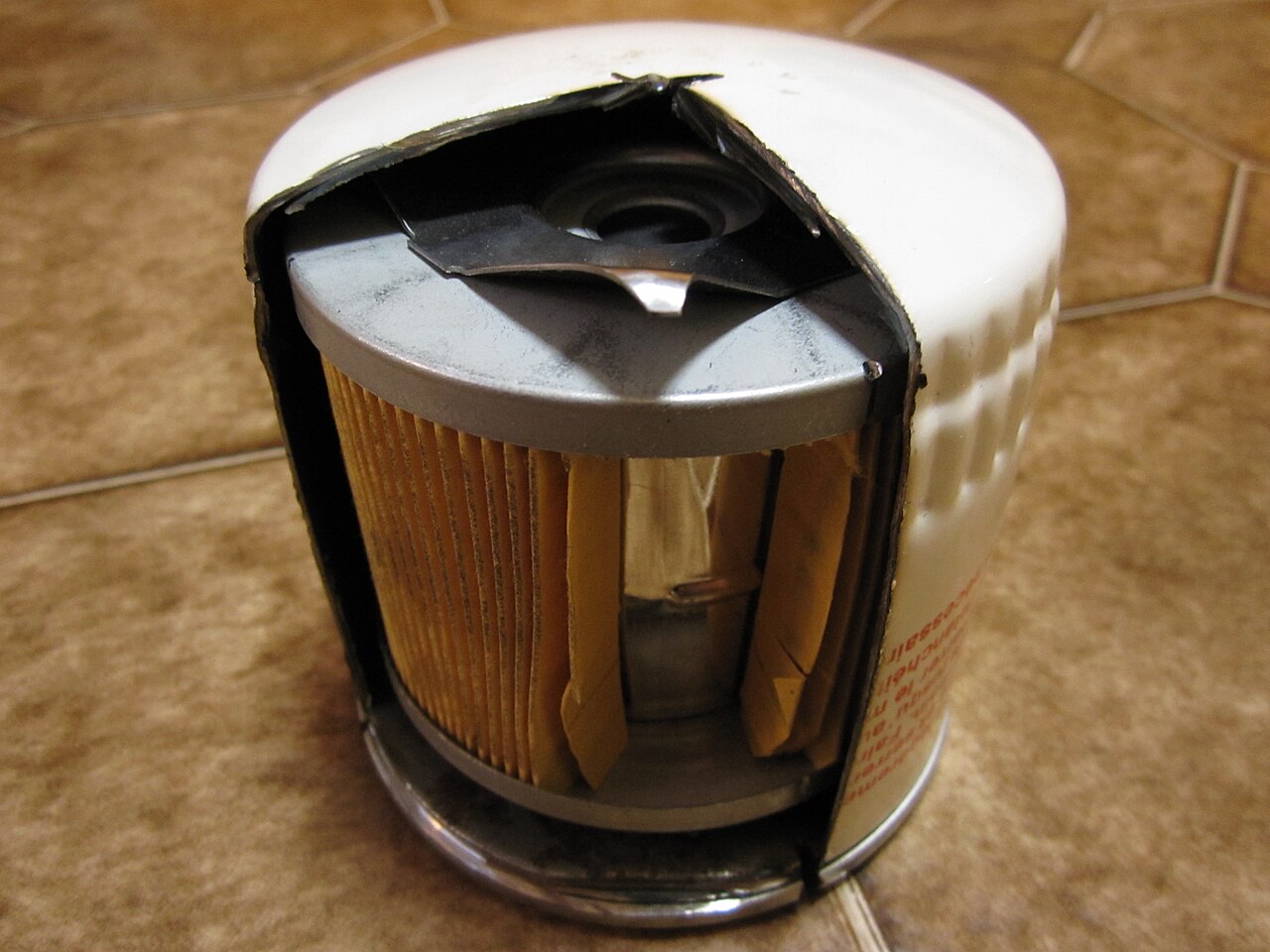
After maintenance, compare the result under equivalent conditions and record what changed. That turns a gauge reading into a defensible trend. The cover is a cutaway engine-oil filter; it illustrates one construction without establishing the characteristics of another assembly.
Further reading
Donaldson - Effective filtration performance and energy use ↗