A spray dryer does more than remove water from a liquid. Its atomization stage helps establish the droplets from which particles form, making the feed system and the required powder characteristics part of the same equipment-selection problem.
Begin with the feed, then describe the powder
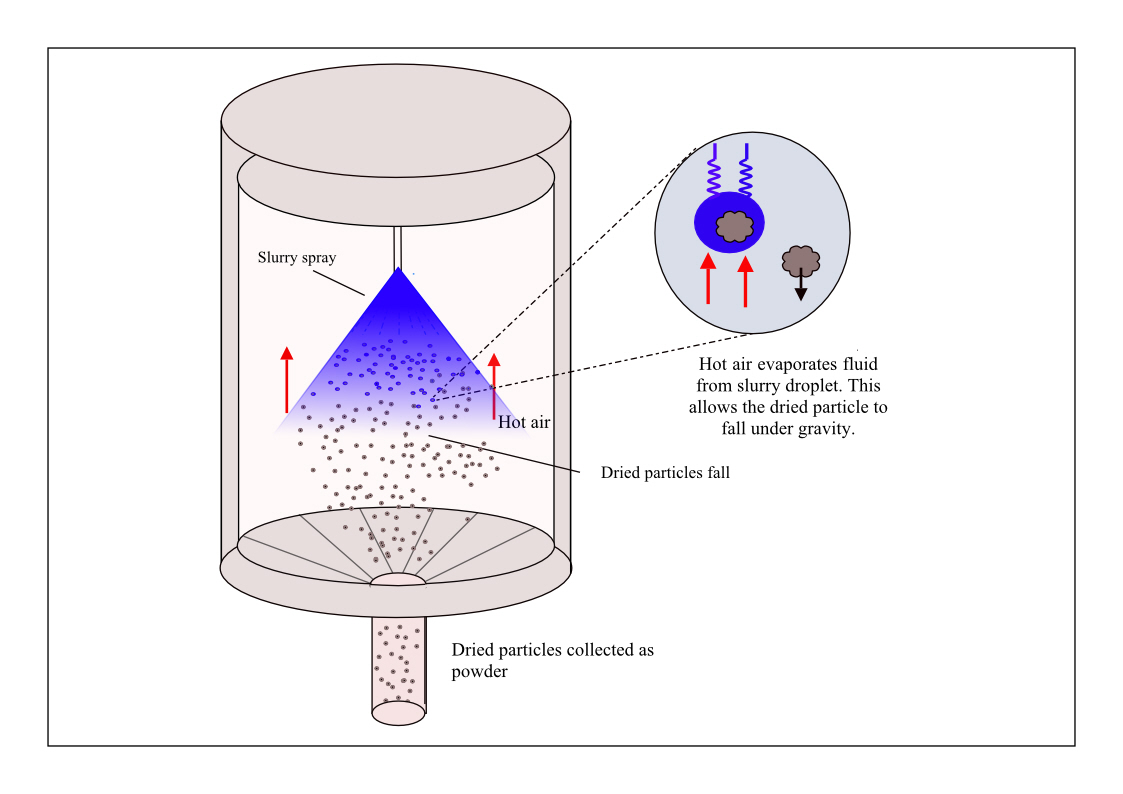
GEA’s drying-technology overview describes spray drying of liquids such as solutions, emulsions and pumpable suspensions. The feed is atomized into droplets, which contact drying gas and form particles as liquid evaporates.
That sequence gives a practical starting point for a supplier enquiry. State the feed composition, solids content, viscosity behavior, temperature range and any suspended material. Then define the powder properties that matter to the next operation, rather than specifying only evaporation capacity.
Compare atomization methods on a common duty
Nozzle and rotary atomization create a spray by different mechanisms. GEA’s spray-drying brochure discusses nozzle systems using pressure or atomizing gas as well as rotary atomizers. The underlying comparison is relevant beyond the brochure’s particular application sector; it is not an assertion that a chemical plant has pharmaceutical qualification.
Ask suppliers to compare their proposed method at the same feed and powder requirements. Include throughput range, utilities, maintenance access and the effect of feed variation. Avoid ranking an atomizer by one nominal operating value while the alternatives are being quoted for different liquids or duties.
| Enquiry item | Why it belongs in the discussion |
|---|---|
| Feed solids and viscosity range | Defines the material the atomizer must handle |
| Required particle-size distribution | Connects droplet formation to the product target |
| Outlet moisture and temperature limits | Constrains the drying duty |
| Powder recovery and handling | Extends the comparison beyond the drying chamber |
Use trials to test the difficult assumptions
A useful trial plan states what will be measured and how the sample represents production feed. Ask for particle-size results, moisture outcome, yield accounting and observations of deposits or handling problems. Record the feed condition and operating range alongside the result.
An attractive powder sample alone cannot establish continuous production behavior. The project review should identify which scale-up assumptions remain and how the supplier proposes to resolve them.
The cover is a simplified process illustration. It explains droplet-to-powder conversion without defining the gas-flow arrangement or detailed geometry of every spray dryer. Final equipment selection should follow the actual feed, product specification and demonstrated operating envelope.
Further reading
GEA - Drying and particle-formation technologies for chemicals ↗