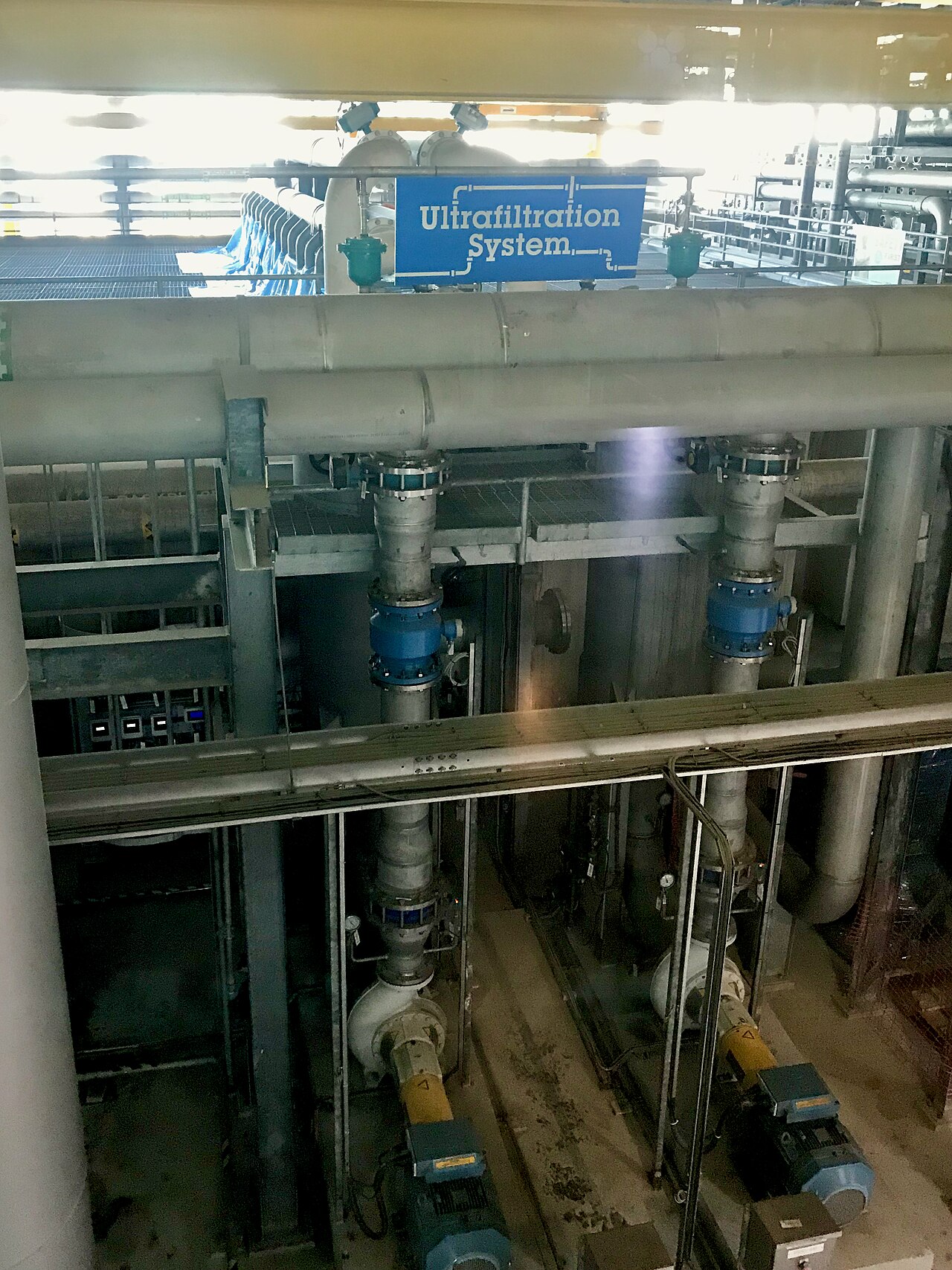
An ultrafiltration system can substantially improve the particle quality of water entering reverse osmosis. It does not make every downstream deposit a membrane-integrity problem. A useful investigation separates what the upstream barrier retains from what remains dissolved in the water.
Start with the separation mechanism
DuPont describes ultrafiltration as a membrane process used to remove suspended material and other contaminants within its separation capability. Retention depends on the membrane and the material being challenged. A good particle barrier should not be treated as a desalination stage.
Low turbidity therefore answers a narrower question than a complete feed-water analysis. It helps describe suspended material; it does not establish the concentrations of dissolved salts or all organic compounds. A stable visual appearance is also a weak basis for deciding whether the RO operating chemistry remains suitable.
Keep three questions separate
| Question | Evidence to request | Decision it supports |
|---|---|---|
| Is the particle barrier performing? | UF integrity results and consistent sampling of permeate particle quality | Investigate bypass, integrity or upstream loading |
| Can dissolved species concentrate into scale? | Feed chemistry and the proposed RO recovery | Review scale-control design |
| Has the RO itself changed? | Normalized operating trends and deposit evidence where available | Distinguish a feed change from an operating or maintenance issue |
The FilmTec technical manual treats particulate control, scale prevention and other pretreatment duties separately. Its structure reflects an important boundary: reducing suspended matter does not remove the need to assess the chemistry of the concentrated stream.
Write an interface specification
For a procurement review, ask the UF supplier to identify the quality parameters it guarantees and the conditions attached to them. Then ask the RO designer to identify the remaining feed limits and how the proposed operating range meets them. Put both answers on the same process diagram.
For example, if turbidity remains stable while RO performance deteriorates, do not immediately increase UF cleaning frequency. First assemble the sampling dates, feed analysis, recovery and normalized RO trends. That is a diagnostic sequence to test a hypothesis, rather than evidence that a particular plant has scaling.
The handover should define sampling points, owners and responses to a change. Clear responsibility between treatment stages is more useful than a broad claim that upstream filtration has eliminated fouling.
Further reading
DuPont - Ultrafiltration technology ↗
DuPont - FilmTec reverse osmosis and nanofiltration technical manual ↗