A purchase specification that says fail closed leaves an important question open: fail after which event? Losing an electrical command is different from losing the air that moves a pneumatic actuator. The required response should be stated for the complete assembly and each relevant failure condition.
Separate the initiating events
Emerson’s FieldQ documentation explicitly makes position after failure dependent on operating principle, assembly configuration and the kind of failure. That is a useful starting point for a project cause-and-effect schedule.
List loss of control signal, electrical supply and instrument-air supply separately. Where combinations or recovery behavior matter, include them too. Specify the required valve position and any relevant timing or feedback requirement without assuming all failures produce the same movement.
A spring is part of a sized mechanism
A spring-return actuator can provide a defined return movement when configured and sized for its duty. It must still overcome the valve’s required forces or torque through the relevant travel.
Fisher’s actuator-sizing guidance distinguishes spring and valve-force requirements when assessing fail-open and fail-closed arrangements. The practical lesson is to obtain the supplier’s sizing basis for the actual valve and process conditions, rather than treating the presence of a spring as complete evidence of performance.
Write a cause-and-effect table
| Event to define | Evidence to request |
|---|---|
| Control command disappears | The configured logic and resulting valve response |
| Electrical supply is lost | The solenoid or controller state and resulting movement |
| Instrument air is lost | The actuator and pneumatic-circuit response |
| Supplies return | Restart behavior and any required operator action |
The process designer must choose the appropriate final state for the application. An open or closed position is not inherently the correct choice for every service.
Include the valve, actuator, solenoid, positioner and relevant accessories on the reviewed assembly drawing. Identify any stored-energy component and the maintenance procedure needed for it.
Verify the assembled behavior
An agreed acceptance test should demonstrate the specified events under an approved procedure, with the process safely controlled. Record the actual position, response and indication. An actuator datasheet or a normal open-close cycle does not by itself prove every failure response.
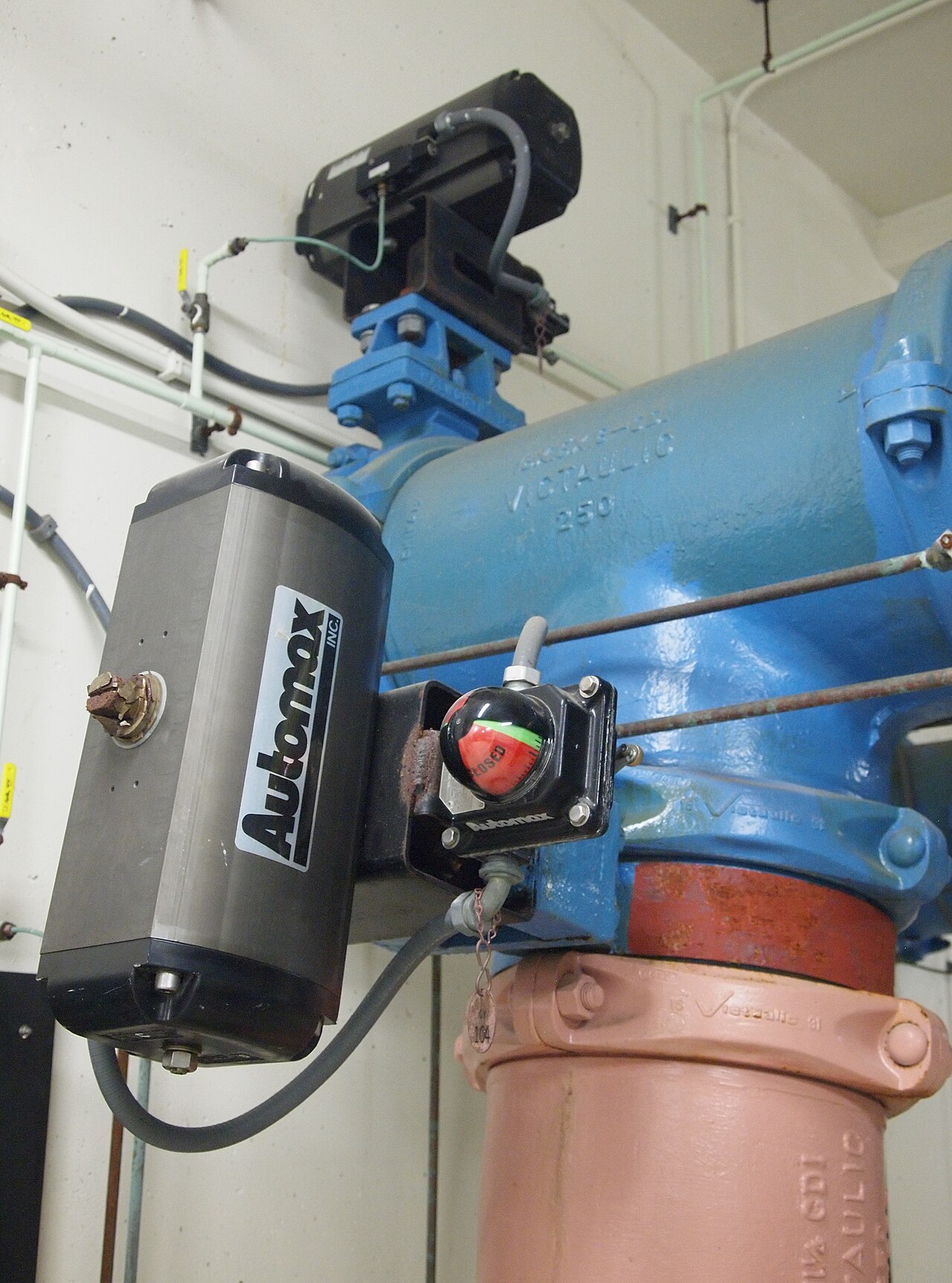
The reference photograph shows pneumatic rack-and-pinion actuators. Their appearance alone does not establish spring configuration or the failure behavior of the complete installation.
Further reading
Emerson - FieldQ actuator installation and operation manual, position-after-failure section ↗
Emerson Fisher - Actuator sizing and spring-biased piston-actuator guidance ↗